Meta title: Best Phone System for Small Business in Canada | Intratel Meta description: The best phone system for small business in Canada keeps your number, call history and caller ID with the business. See how Hosted PBX compares. URL slug: /best-phone-system-small-business-canada/
What Is the Best Phone System for a Small Business in Canada?
Quick answer: For most Canadian small businesses with two or more people taking calls, the best phone system is a Hosted PBX with mobile app extensions. Staff keep the smartphones they already carry, while the business owns the number, call history and caller ID. SIP trunking suits businesses that already own a phone system, and on-premise PBX suits large businesses and call centres.
Why Do Small Businesses Outgrow Personal Cell Phones?
Small businesses outgrow personal cell phones once more than one person answers calls, because each phone becomes a separate line the business doesn’t own. A solo owner can manage on one cell phone, but the best phone system for a small business in Canada has to work for a whole team.
Most Canadian businesses with staff are small. As of December 2024, there were 1.10 million employer businesses in Canada, and 1.08 million (98.2%) were small businesses with 1 to 99 paid employees (ISED, Key Small Business Statistics 2025).
Customers are also more careful about which calls they answer. In TransUnion’s Canadian consumer research, 61% said they have missed legitimate calls due to fraud concerns.
What Are the Main Types of Small Business Phone Systems?
The main options are personal cell phones, separate business mobile plans, traditional landlines, Hosted PBX, SIP trunking and on-premise PBX. A few terms help explain the differences:
- VoIP (Voice over Internet Protocol) carries phone calls over your internet connection instead of traditional phone lines.
- PBX (private branch exchange) is the system that runs your business phone features: extensions, call routing and voicemail.
- Hosted PBX, also called Cloud PBX, is a PBX run by your provider in its data centre, so there is no PBX equipment to house or maintain at your office.
- SIP trunking provides digital phone lines for a PBX you already own, replacing expensive landlines.
- A mobile app extension puts your business line on an employee’s own smartphone through an app.
| Phone setup | Best fit | Main limitation |
|---|---|---|
| Personal cell phones | A solo owner | The business doesn’t own the number, call history or caller ID |
| Separate business mobile plans | Teams that want company-issued devices | Extra plans, and often two phones per person |
| Traditional landline | One desk at one location | Calls stay at the desk; costs rise with every line |
| Hosted PBX with mobile app extensions | Most small businesses with two or more people taking calls | Needs a stable internet connection, with an outage backup |
| SIP trunking | Businesses that already own a PBX | Digital lines only; features come from your existing PBX |
| On-premise PBX | Large businesses and call centres | Hardware to buy, house and manage |
For most small teams, a business phone app is more cost-effective than separate business mobile plans: it puts the business line on the phone each employee already owns, with no second device or extra plan.
Why Do Customers Ignore Calls from Personal Numbers?
Customers ignore calls from personal numbers because an unfamiliar number could be spam or a scam. In a May 2025 survey of 1,231 Canadians, one-third said they will never answer an unknown number (Narrative Research and Logit Group). The findings highlight the challenges businesses face when trying to reach customers from unfamiliar phone numbers.
What Happens to Customer Calls When an Employee Leaves?
With personal cell phones, customer calls leave with the employee, because customers saved that person’s number, not the business’s. The business can’t redirect those calls or see the conversations behind them.
With a business extension, the business retains control of its phone numbers and associated call records. Every call is logged, and calls can optionally be recorded. When someone leaves, you disable their extension, and the business number, call logs and recordings stay with the company. Calls can be rerouted to the person taking over the role, so customers keep calling the same number.
How Can Small Teams Keep Business Calls Out of Personal Time?
Small teams keep business calls out of personal time by setting business-hours rules on each extension, so after-hours calls go to voicemail instead of ringing a personal phone. With voicemail-to-email and transcription, each message arrives in the inbox as readable text, so nothing is missed and it can wait until morning.
During the day, call forwarding rules send a call to a teammate or a shared number when someone is busy or away. Customers reach someone, and staff never need to hand out personal numbers to cover for each other.
How Do Mobile App Extensions on a Hosted PBX Work?
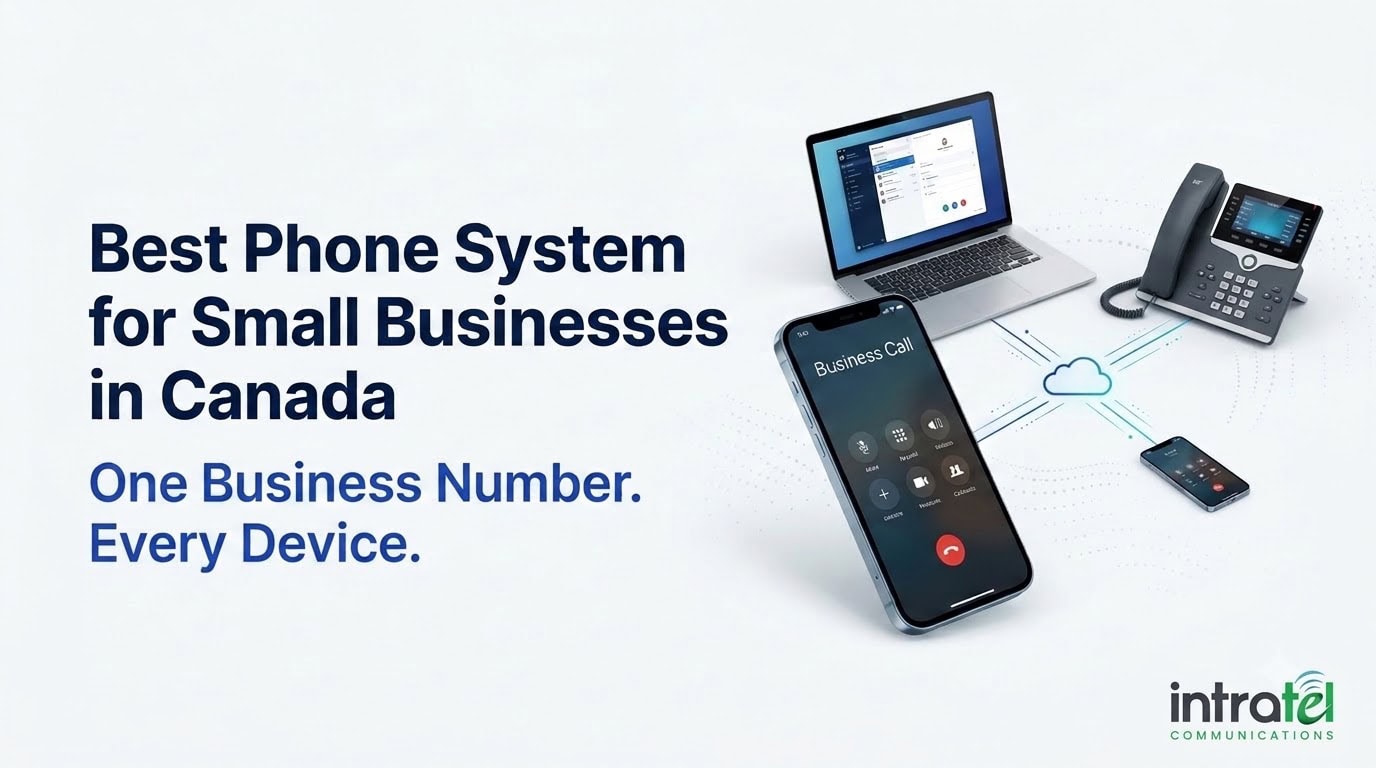
A mobile app extension connects an employee’s smartphone to your Hosted PBX, so calls ring on their phone under the business number. The same extension can run on a desk phone or a softphone (calling software on a computer), making the system flexible enough to work with different hardware and software setups.
An auto attendant, the automated greeting that routes callers by dial-pad menu, sends each call to the right extension. Shared numbers and call forwarding suit construction crews and field service teams who move between job sites.
Two common concerns:
- Internet outages. Intratel’s emergency forward feature, included at no extra cost, sends incoming calls to a backup cell phone if your power or internet goes down.
- Where calls go. Intratel works exclusively and directly with Canadian data centres and carriers, so your calls and data stay in Canada. Intratel serves businesses across Canada, with a local focus on Burlington, Hamilton, Oakville, Mississauga, Brampton and Toronto.
How Much Does a Small Business Phone System Cost in Canada?
Hosted PBX pricing scales with your team, so a small business pays only for what it needs and adds users as it hires. At Intratel, pricing depends on the number of users, features required and level of support, rather than a one-size-fits-all package. Calling rates and included features vary by plan, and number porting is included at no extra cost. You can review Intratel’s Plans and Pricing page or request a free quote based on your business needs.
Compare that with your current mobile, landline and long-distance costs.
Key Takeaways
- A Hosted PBX with mobile app extensions is the best fit for most Canadian small businesses with two or more people taking calls.
- Personal cell phones leave the business without control of its numbers, call history or caller ID.
- One business number on every outgoing call is easier for customers to recognize than a mix of personal or hidden numbers.
- Disabling an extension keeps the number, call logs and recordings with the business when staff leave.
- Intratel’s Hosted PBX pricing is based on your number of users, features and support, with number porting included.
💬 Common Questions
Can I use my cell phone as a business line?
Yes. A Hosted PBX mobile app adds a business extension to your existing smartphone, so you make and take business calls under the business number without a second phone or plan.
What is the difference between VoIP and Hosted PBX?
VoIP is the technology that carries calls over the internet. A Hosted PBX is a complete business phone system, with extensions, an auto attendant and call routing, that uses VoIP and is run by your provider.
Can I keep my business number when I switch?
Usually, yes. You can keep your phone number when you change phone companies as long as you stay within your local exchange area, and you should not cancel your old service before the switch, as recommended by the CRTC.
What happens to my calls if the internet goes down?
With Intratel, incoming calls are forwarded automatically to a backup cell phone during a power or internet outage, at no extra cost.
So, What Is the Best Phone System for Your Small Business?
The best phone system for a small business in Canada is one the business owns: for most teams past the solo stage, a Hosted PBX with mobile app extensions. It keeps the flexibility of mobile phones, and every new hire is just another extension.
Book Your Free Demo Today to see how Intratel’s Hosted PBX mobile app puts your business number on your team’s own phones, or Try It Risk-Free for 30 Days. Prefer to talk it through? Call 1-866-409-VoIP (8647) or request a free consultation.