📌 Summary
Business VoIP can provide the complete business calling environment through one telecom provider. Microsoft Teams Phone adds cloud calling capabilities to Teams, while external PSTN calling requires a connectivity option such as Microsoft Calling Plan, Operator Connect, Teams Phone Mobile, or Direct Routing. The two can compete in some deployments, but they can also work together through Direct Routing.
- What each one is: Business VoIP, delivered as a Hosted PBX, bundles phone-system features and carrier service. Teams Phone is a cloud phone system inside Microsoft 365 that needs a separate PSTN connection.
- What it costs: Microsoft Teams Phone requires an eligible Microsoft Teams or Microsoft 365 licence plus a PSTN connectivity option. Intratel Hosted PBX starts at $19.95 per extension monthly with unlimited calling in Canada.
- The hybrid option: Direct Routing puts a Canadian provider behind Teams, so no Microsoft calling plan is needed.
- How to decide: count how many staff work inside Teams all day and how many need a phone at a desk.
For businesses already using Microsoft 365 and Teams, adding business calling inside the same interface can seem like a natural next step. Someone asks why the company still pays a separate phone bill, the idea gains momentum, and then the quotes come back and the picture gets murky.
The trouble is usually in how the comparison gets framed. The key difference is that business VoIP from a telecom provider can include both the phone-system features and the carrier service, while Microsoft Teams Phone requires a separate PSTN connectivity option for external calling. Everything else follows from that.
💼 Why Are Businesses Comparing Business VoIP and Teams Phone?
Removing a vendor relationship is genuinely appealing, and consolidating calling into software staff already use has obvious logic to it.
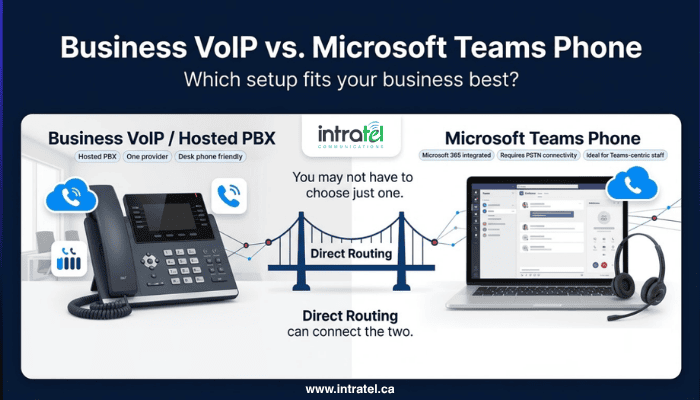
What surprises people is the structure underneath:
- Teams Phone is a separate purchase. It is not bundled into most Microsoft 365 plans and sits on top of an eligible Teams licence rather than replacing one.
- External calling is an additional requirement. Teams Phone needs PSTN connectivity through Microsoft Calling Plan, Operator Connect, Teams Phone Mobile, or Direct Routing.
- The carrier question stays. Someone still carries the calls, owns the numbers, and answers when call quality drops.
🔍 What Is the Difference Between Business VoIP and Microsoft Teams Phone?
Business VoIP, delivered as a Hosted PBX, is a complete cloud phone system managed by a telecom provider. Extensions, call routing, an auto attendant that greets callers and moves them through dial-pad menus, voicemail to email, call queuing, and the carrier connection all arrive from one vendor on one bill.
Microsoft describes Teams Phone Standard as a cloud-based phone system, and it is one. The distinction is in delivery rather than category. Microsoft states the dependencies plainly: an eligible Microsoft Teams licence sits underneath it, and external calling must be added through Microsoft Calling Plan, Operator Connect, Teams Phone Mobile, or Direct Routing.
So the practical question is not which product is a real phone system. It is how many vendors stand between your staff and a working outside line.
📞 How Does Microsoft Teams Phone Connect to the Phone Network?
Microsoft documents four routes to PSTN connectivity: Microsoft Calling Plan, Operator Connect, Teams Phone Mobile, and Direct Routing. For businesses comparing Teams Phone with a traditional business phone system, Calling Plan, Operator Connect, and Direct Routing are typically the most relevant options.
-
- Microsoft Calling Plan: Microsoft acts as your PSTN operator, providing phone numbers, PSTN connectivity, and calling services.
- Operator Connect: A certified third-party operator carries the calls under a contract with that provider.
- Teams Phone Mobile: a participating mobile operator connects a SIM-enabled business number with Teams, allowing users to use the same business number on their mobile device and in Teams.
- Direct Routing: you use any operator you choose, connected through a certified Session Border Controller.
Microsoft’s own guidance points to Direct Routing for organizations that already have a carrier relationship, need to connect third-party PBXs or analog devices, require advanced voice routing, or want more control over their voice setup (Microsoft Learn, Plan Direct Routing). That describes a great many established Canadian businesses.
With Microsoft Teams Direct Routing from Intratel, no Microsoft calling plan is required. Microsoft supplies the phone system, Intratel supplies the calling. One detail worth stating: a Teams Phone licence per user still applies. Direct Routing removes the Microsoft calling plan from your bill, not the licence.
💰 What Does Each Option Cost in Canada?
Microsoft Teams Phone pricing depends on the licence and PSTN connectivity option selected. An eligible Microsoft Teams or Microsoft 365 licence is required, along with a connectivity option for external calling.
Intratel’s Hosted PBX plans and pricing start at $19.95 per extension monthly on Entry Level, including unlimited calling in Canada, one local line, and an IVR voice menu auto attendant. Business Standard is $24.95 per extension, adding unlimited USA and Canada calling, mobile and desktop apps, call queuing, hunt groups, and CRM integration.
Microsoft typically licenses Teams Phone per user, while Intratel Hosted PBX pricing is based on extensions, so businesses should compare the actual number of licensed users and extensions they require. The fair comparison is the total cost of a working phone setup, including licensing and connectivity.
⚙️ Which Handles Business Calls Better?
| Capability | Intratel Business VoIP | Teams Phone + Microsoft Calling Plan | Teams Phone + Intratel Direct Routing |
| Auto attendant and call queues | Yes | Yes | Yes |
| Voicemail transcription | Yes | Yes | Yes |
| Call recording | Add-on, included on Business Premium | Yes | Yes |
| Desk phone support | Yes | Certified devices | Yes |
| Intratel as Canadian voice provider | Yes | No | Yes |
| Microsoft licence required | No | Yes | Yes |
Feature lists have largely converged, so checklists will not settle this. Teams has the advantage for staff who work inside Microsoft 365 all day, since presence, chat and calling sit in one window. Hosted PBX has the advantage where phones are the job, because desk phones, reception setups and heavy queue traffic are what it is built around, with no Microsoft licence underneath the cost.
🍁 Why Does the Canadian Voice Provider Behind Teams Matter?
Whichever interface your staff dial from, someone carries the calls, and that decision tends to outlast the software choice.
Intratel is a 100% Canadian VoIP provider, building voice on its own Canadian network with multiple data centres, geographic redundancy and multiple failover points. To be precise: in a Teams deployment, the Microsoft platform still sits in the call path, so the Canadian network covers Intratel’s side of the connection.
There is also the question of who picks up when something breaks. With Hosted PBX or Direct Routing from Intratel, one Canadian provider owns the carrier connection, the numbers and the migration. Intratel supports businesses across Burlington, Hamilton, Oakville, Mississauga, Brampton and Toronto, and serves organizations Canada-wide.
🧭 Which Is Better for Your Business?
- Hosted PBX is the practical default for businesses that want a complete business phone system without adding Microsoft licensing requirements, especially where staff rely on desk phones, reception workflows, call queues, or dedicated business extensions.
- Teams Phone with Direct Routing suits organizations where nearly everyone already works in Microsoft 365 and holds the licences.
- Both together suits mixed teams: Hosted PBX for reception, sales and support, Teams for office staff, one carrier behind both.
Count how many staff genuinely work inside Teams all day and how many need a phone in front of them. That split usually settles the question before pricing enters the conversation.
💡 Key Takeaways
- Business VoIP can combine phone-system features and carrier service from one provider. Teams Phone needs a separate PSTN connectivity option.
- Direct Routing lets you keep your own carrier, though a Teams Phone licence per user still applies.
- Microsoft licenses per user and Intratel prices per extension, so compare the users and extensions you actually need.
- Features have converged. Decide on workforce shape, carrier and support instead.
- The two can compete in some deployments and can also run alongside each other, so this is not always an either-or choice.
❓ Common Questions
Is Microsoft Teams Phone the same as VoIP? Microsoft Teams Phone uses VoIP technology and functions as a cloud phone system within Teams. The main difference is how calling is delivered: business VoIP from a provider such as Intratel can combine phone-system features with carrier connectivity, while Teams Phone requires a PSTN connectivity option such as Microsoft Calling Plan, Operator Connect, Teams Phone Mobile, or Direct Routing.
Do I need a Microsoft calling plan to make calls from Teams? No. Direct Routing lets you use your own carrier. With Intratel carrying the calls, no Microsoft calling plan is required, though a Teams Phone licence per user still applies.
What is Direct Routing? Direct Routing connects your telecom provider to Microsoft Teams through a certified Session Border Controller, so calls to and from the public phone network run over your provider’s network.
Can I keep my current phone number? Yes. Existing numbers can be ported to Intratel and used with Hosted PBX or a Teams deployment. Porting carries a one-time charge per number.
Is Teams Phone less expensive than Hosted PBX? The less expensive option depends on your existing Microsoft licences, number of users or extensions, calling requirements, hardware needs, and connectivity choice. Businesses should compare the total cost of a working phone setup rather than the base licence alone.
Can I use Hosted PBX and Microsoft Teams together? Yes, and many businesses do. Front-line staff use Hosted PBX extensions while office staff call from Teams, both running on the same Canadian carrier.
📞 Ready to Compare Both Options Side by Side?
Intratel will map your current setup and price Hosted PBX against Teams Direct Routing with real numbers, not licence estimates. Book Your Free Demo Today, or call 1-866-409-8647 to talk it through with a Canadian provider. Try It Risk-Free for 30 Days.