Direct Answer
An AI-powered VoIP phone system for small business is a Hosted PBX cloud phone platform with intelligent capabilities layered on top, including voicemail transcription, automatic call summaries, intent-based call routing, AI-assisted after-hours call handling, and noise suppression. For most Canadian SMBs, Hosted PBX is the preferred deployment model because it avoids the complexity and hardware management requirements associated with on-premise PBX systems. It runs over the internet rather than a traditional phone line.
Summary
This guide explains what an AI-powered VoIP phone system actually does at small business scale, which AI features deliver measurable returns for a Canadian operation with 5 to 50 employees, which features are enterprise marketing dressed up for SMBs, what these systems realistically cost, and how to roll one out without overspending. It is written for Canadian small business owners evaluating whether to upgrade their phone system, not for enterprise contact-centre buyers.
Why Do Small Businesses Need a Realistic Lens on AI-Powered VoIP?
Direct answer: Most AI-powered VoIP marketing draws on enterprise contact-centre case studies, which do not reflect the call volumes or workflows of a 5-to-50-person Canadian small business. The features that matter at SMB scale are different from the ones featured in vendor demos.
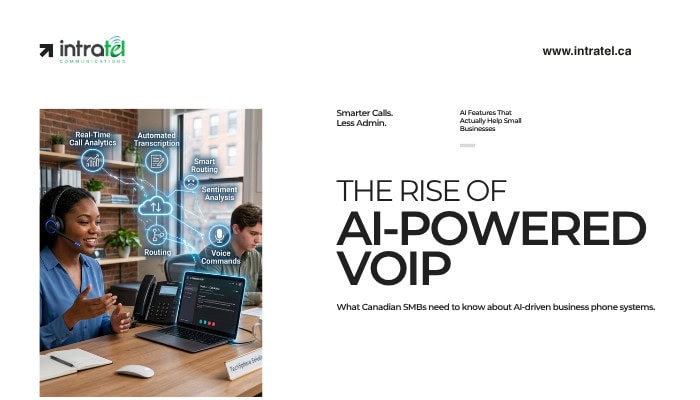
Cutting Through the Hype: AI in a Phone System at SMB Scale
Canadian small business AI adoption has accelerated faster than provider messaging has caught up. This guide delivers a feature-by-feature breakdown of which AI capabilities deliver value at SMB scale, which require enterprise volume, the Canadian-specific cost and adoption considerations, and a practical decision framework.
How Does an AI-Powered VoIP Phone System Work?
Direct answer: AI-powered VoIP works by routing voice calls over the internet through a Hosted PBX platform, then applying speech-to-text models, natural language processing, and intent detection to those calls in real time or post-call. The Hosted PBX is the substrate; AI is a software layer that adds transcription, summarization, and routing intelligence on top.
The Three Layers Explained
Most AI-powered VoIP systems operate as three stacked layers.
- Layer 1, the call transport: VoIP carries the voice call over the internet using SIP signalling and IP packets, replacing the analog landline.
- Layer 2, the Hosted PBX: The provider’s cloud-hosted call control system manages extensions, voicemail, IVR menus, call queues, and routing rules. The customer connects through IP phones, mobile apps, or softphones.
- Layer 3, the AI capabilities: Speech-to-text models transcribe voicemails and recordings. Natural language processing generates call summaries. Intent classification detects what the caller wants and routes accordingly. Audio processing models suppress background noise.
Intratel’s own platform reflects this architecture, offering call transcription that, in their words, can be fed into AI systems for further processing, alongside AI-generated voice greetings as add-ons to standard Hosted PBX.
Which AI Features Actually Matter at Small Business Scale?
Direct answer: Five AI features pay back at SMB scale: voicemail transcription, automatic call summaries, intent-based call routing, an AI virtual receptionist for after-hours handling, and noise suppression. Four other features (sentiment analysis, agent coaching, predictive routing, quality scoring) need enterprise call volumes to be worth the cost.
High-ROI Features for 5 to 50 Employees
These features deliver value on every individual call, which means they pay back regardless of total call volume.
- AI voicemail transcription: converts voicemails to searchable text in seconds.
- Automatic call summaries: generates a written record of completed calls for follow-up and CRM logging.
- Intent-based call routing: connects callers to the right person on the first try based on what they say.
- AI virtual receptionist for after-hours handling: routes callers, captures caller information, and directs urgent requests appropriately outside business hours, while escalating more complex interactions to staff when needed.
- Noise and echo suppression: improves call audio for remote staff working from home or shared spaces.
Enterprise-Skewed Features Most SMBs Should Skip
These features need call volumes of hundreds or thousands per day, plus dedicated agent teams, before the AI generates enough data to be useful.
- Real-time sentiment analysis: designed for live agent assist in contact centres.
- Agent coaching and scoring: built for managing dedicated agent teams against performance benchmarks.
- Predictive call routing models: require enterprise-volume training data to outperform basic rule-based routing.
- Post-call AI quality scoring: designed for large enterprise call environments with structured call protocols.
AI Feature Comparison: SMB vs Enterprise Fit
| AI feature | Pays back at SMB scale (5-50 staff)? | Why |
|---|---|---|
| Voicemail transcription | Yes | Per-call value, regardless of volume |
| Automatic call summaries | Yes | Can help reduce administrative workload on routine calls |
| Intent-based call routing | Yes | Reduces caller frustration on first contact |
| AI virtual receptionist (after-hours) | Yes | Helps reduce missed-call opportunities without adding payroll costs |
| Noise and echo suppression | Yes | Improves call quality for remote staff |
| Real-time sentiment analysis | No | Needs hundreds of calls per day to be useful |
| Agent coaching and scoring | No | Designed for dedicated agent teams |
| Predictive call routing models | No | Requires enterprise-volume training data |
| Post-call AI quality scoring | No | Built for regulated contact-centre operations |
Bottom line: Providers who lead their SMB pitch with sentiment analysis or agent scoring are running an enterprise playbook on a small business audience. The honest signal is a provider whose SMB tier emphasizes transcription, summaries, and routing.
How Does AI-Powered VoIP Improve Productivity for a Canadian Small Business?
Direct answer: AI-powered VoIP can help improve operational efficiency through small per-call productivity gains, multiplied across hundreds of calls per month. Voicemail transcription and automatic summaries reclaim staff admin time. AI-assisted call handling features capture after-hours calls. Intent-based routing reduces first-contact frustration. The math is incremental, not transformational.
Where the Hours and Dollars Actually Come From
Voicemail transcription and automatic call summaries reclaim staff time on every call. Instead of replaying messages and writing notes, customer-facing staff get a searchable text record they can scan in seconds. Across a month of calls, the recovered admin time is often where the operational efficiencies may help offset part of the per-user licensing cost.
AI-assisted after-hours call handling can help businesses respond more consistently to inbound inquiries without adding payroll. Half of consumers have already engaged with Voice AI and want to use it for natural, conversational interactions. Intent-based routing reduces caller frustration on first contact. Customer expectations for faster response times continue to increase across support channels. AI routing can help connect callers to the right person on the first try.
Bottom line: Evaluate AI VoIP on time saved per call and missed-call recovery, not on enterprise-style metrics like average handle time across thousands of agents.
How Much Does an AI-Powered VoIP Phone System Cost in Canada?
Direct answer: Canadian Hosted PBX plans start at approximately $16.95 per line per month for base tiers, based on Intratel’s published pricing. AI-enabled tiers are priced higher depending on the feature set. Total cost depends on user count, feature mix, and whether AI capabilities are bundled or charged as add-ons.
What to Expect as AI Features Move From Add-On to Standard
AI features in business phone systems are following the same pricing curve as cloud telephony itself. They started as premium add-ons and are increasingly bundled into mid-tier plans, particularly for transcription and summaries.
Canadian SMB pricing benchmarks are useful here. Intratel’s published Hosted PBX pricing starts at $16.95 per line per month, with AI-related capabilities like call transcription and AI-generated voice greetings available as add-ons. When evaluating providers, owners should compare a bundled-AI tier against a base tier plus standalone AI tools to understand true incremental cost.
The Three Cost Dimensions Most Owners Miss
- Monthly per-user pricing: the obvious lever, and the easiest one for providers to compete on.
- Where voice and transcript data is processed: some providers process voice data outside Canada, while others keep services within Canadian networks and data centres.
- What happens to your recordings and transcripts if you switch providers: the question most providers do not volunteer until asked. Ask providers how recordings and transcripts can be accessed or transferred if you move services later.
Bottom line: Many Canadian businesses prefer providers that keep voice and transcript services within Canada.
How Should a Small Business Roll Out an AI-Powered VoIP System?
Direct answer: Plan for a 30 to 60 day rollout in three phases: audit current call patterns first, evaluate providers based on features, support, pricing, and Canadian service availability, then pilot one or two features with measurement against the baseline. Most unsuccessful deployments stem from rolling out too many features at once without baseline metrics.
From Evaluation to Live Deployment in 30 to 60 Days
Phase one, weeks one and two: audit current call patterns.
- Document call volume: by day and hour, including peak periods.
- Measure missed-call rate: the percentage of calls that go to voicemail or are abandoned.
- List the highest-frequency caller intents: booking, support, quote requests, billing questions, and so on.
- Capture average response time: how long it takes to return a missed call or respond to a voicemail.
This baseline determines which AI features will actually pay back. Without it, feature selection is a guess.
Phase two, weeks two through four: provider selection using AI-specific criteria. Beyond standard Hosted PBX evaluation (uptime, Canadian infrastructure, no-contract terms), AI-specific criteria include where voice data is processed, what transcription accuracy looks like for Canadian English and French, how deep the CRM integration goes, and whether AI features are bundled or upsold.
Phase three, weeks four through eight: pilot, train, measure. Start with one or two AI features. Transcription and intent-based routing are the safest first picks for an SMB. Train staff on the new workflow, then measure against the baseline. McKinsey research on AI in service operations consistently finds that scaled deployments succeed when scoped to clear, measurable use cases rather than full-stack rollouts. Although the McKinsey research is enterprise-focused, the disciplined, scoped-rollout principle applies at any scale.
Bottom line: AI VoIP adoption fails most often not because the technology underperforms, but because owners deploy too many features at once without baseline metrics.
What Are the Red Flags When Evaluating an AI-Powered VoIP Provider?
Direct answer:Watch for vague accuracy claims, vendor promises that AI fully replaces staff, unclear information about where services are hosted, and provider pitches built on enterprise contact-centre case studies that do not apply to a small business. Realistic providers describe AI as a productivity layer, not a workforce replacement.
Setting Honest Boundaries Around the Technology
AI voicemail transcription and call summaries are accurate but not flawless. Word error rates vary with accent, background noise, and audio quality. AI-generated transcripts should still be reviewed for accuracy, especially for detailed customer conversations.
Conversational AI virtual receptionists handle routine call flows well, but escalate to humans on complex requests. Owners should define a clear handoff path for any caller intent the AI cannot resolve. AI-assisted routing features route and qualify calls; they do not replace staff handling for complex customer interactions.
Specific Red Flags to Watch For
- Promises to fully replace your receptionist: no current SMB-tier AI handles complex customer situations end-to-end.
- 100% accuracy claims: no speech model is 100% accurate; vendors making this claim are overselling.
- Guaranteed call resolution rates without volume context: resolution rates depend on call mix and volume, not AI alone.
- Case studies drawn entirely from enterprise contact centres: ask explicitly for SMB customer references in your size range.
- Vague answers about where services are hosted: ask where voice data, transcripts, and AI training data are stored and processed.
Bottom line: Adopt AI as a tool to extend a human team, not replace it. The technology compounds ovr months as the team learns workflows.
How Should a Canadian Small Business Decide on AI-Powered VoIP?
Direct answer: Decide based on call patterns, not feature lists. Start with a baseline audit, prioritize the five high-ROI SMB features (transcription, summaries, intent-based routing, after-hours AI virtual receptionist, noise suppression), choose a provider that processes data within Canada, and pilot before committing to a full rollout.
A Practical Decision Framework for Owners
AI-powered VoIP delivers genuine value to Canadian small businesses, but only when scoped honestly to small business realities. Per-call productivity gains, missed-call recovery, and customer-experience baseline are the right success metrics, not enterprise-style transformation.
The features that consistently provide the strongest practical value at SMB scale are voicemail transcription, automatic call summaries, intent-based call routing, AI virtual receptionist for after-hours handling, and noise suppression. Sentiment analysis, agent coaching, and predictive analytics are typically enterprise skewed.
Canadian-specific considerations should drive provider selection. Where voice and transcript data is processed, accuracy in Canadian English and French, integration with the existing business stack, and contract flexibility all matter. A provider that bundles AI features into standard Hosted PBX plans and processes data within Canada can help simplify provider management and service consistency.
Looking ahead, AI features in business phone systems are increasingly being bundled into base tiers rather than priced as premium add-ons. In Intratel’s view, the strategic question for Canadian small businesses is no longer whether to adopt AI-powered VoIP, but how to scope adoption to deliver value at small business scale.
Key Takeaways
- AI-powered VoIP is a Hosted PBX phone system with intelligent capabilities like transcription, summarization, and intent-based routing layered on top.
- Five AI features commonly provide the strongest practical value at SMB scale: voicemail transcription, automatic call summaries, intent-based call routing, AI virtual receptionist for after-hours handling, and noise suppression.
- Sentiment analysis, agent coaching, predictive routing, and quality scoring need enterprise call volumes to be worth their cost.
- Canadian Hosted PBX pricing starts at approximately $16.95 per line per month, based on Intratel’s published rates, with AI capabilities available as bundled features or add-ons depending on the provider.
- Where voice and transcript data is processed matters as much as price; Canadian-based processing may help businesses that prefer Canadian-based services.
- Roll out in three phases: audit call patterns, evaluate providers on AI-specific criteria, then pilot one or two features against baseline metrics.
Frequently Asked Questions About AI-Powered VoIP for Small Business
What is an AI-powered VoIP phone system for a small business?
An AI-powered VoIP phone system is a Hosted PBX cloud phone platform with intelligent capabilities layered on top, including voicemail transcription, automatic call summaries, intent-based call routing, an AI virtual receptionist for after-hours handling, and noise suppression. It runs over the internet rather than a traditional phone line and uses AI models to reduce admin time and missed calls.
Which AI features are worth paying for at small business scale?
Voicemail transcription, automatic call summaries, intent-based call routing, AI virtual call handling for after-hours handling, and noise suppression are the features that provide the strongest practical value for businesses with five to fifty employees. They deliver per-call value regardless of total call volume. Sentiment analysis, agent coaching, predictive routing, and quality scoring need enterprise call volumes to be worth the cost.
How much does AI-powered VoIP cost for a Canadian small business?
Canadian Hosted PBX plans commonly start at approximately $16.95 per line per month for base tiers, with AI-enabled tiers priced higher depending on the feature set. Intratel publishes Hosted PBX pricing at this entry point, with AI add-ons available separately. Owners should compare bundled-AI plans against base plans plus standalone tools and confirm whether AI features are included or upsold separately.
Where is voice data processed when AI features are used?
It depends on the provider. Some providers process voice and transcript data through US-based or international servers, while others keep all processing within Canadian data centres. For businesses handling sensitive customer conversations or those handling sensitive client information, choosing a Canadian-based provider that processes voice and transcript services within Canadian borders helps businesses that prefer Canadian-based services.
Can AI-powered VoIP replace a human receptionist?
No. AI virtual receptionist features handle routine call routing and after-hours coverage well, but they cannot replace the judgment required for complex customer situations. The most successful small business deployments use AI to extend a human team, not replace it. AI manages the predictable call flow; humans handle anything outside that flow.
How is AI-powered VoIP different from regular VoIP?
Regular VoIP carries voice calls over the internet but does not interpret them. AI-powered VoIP adds a software layer that processes the call content, transcribing voicemails, summarizing conversations, detecting caller intent, and routing accordingly. The phone system underneath is the same; the intelligence layer is the difference.
Serving Businesses Across Canada
Intratel supports businesses across Canada while maintaining a strong presence in Burlington, Hamilton, Oakville, Mississauga, Brampton, and Toronto. Canadian businesses evaluating AI-powered Hosted PBX solutions should consider not only features and pricing, but also whether their provider is Canadian-based and supports businesses across Canada.
Ready to Modernize Your Business Communication?
Book Your Free Demo Today and discover how AI-powered Hosted PBX features like voicemail transcription, intelligent call routing, and AI-assisted after-hours handling can improve productivity for your business. Flexible plan options available. Call 1-866-409-VoIP (8647) or visit intratel.ca to get started.