Quick Answer A VoIP phone system for healthcare carries a clinic’s calls over the internet, usually as a cloud-managed Hosted PBX with no on-site PBX server to maintain. For Canadian clinics and medical offices, it means patient calls are answered, routed, and logged reliably; fewer callers are missed, and calls and associated data are hosted on Canadian infrastructure.
Why Patient Call Handling Is the Front Door to Your Clinic
For most clinics and medical offices, the phone is still the front door. Patients call to book appointments, reschedule visits, ask what to bring, or check next steps after a visit. When those calls are answered quickly and routed properly, the clinic feels organized and accessible. When calls go unanswered, patients may become frustrated, leave incomplete messages, or try another clinic.
That matters in a healthcare system where access is already stretched. A reliable phone system helps clinics manage demand more professionally, especially during busy morning periods, lunch hours, staff shortages, and after-hours call periods.
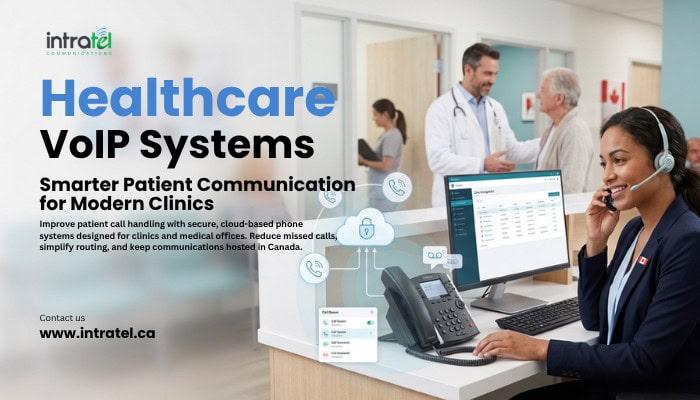
How VoIP Phone Systems Fit into a Modern Medical Office
VoIP phone systems for healthcare sit inside a wider shift toward digital, connected care. Patients are becoming more comfortable using digital tools to access health information, book services, and communicate with providers. For clinics, the phone system now needs to support that same level of access by making calls easier to answer, route, track, and follow up on.
This guide covers what a healthcare VoIP system is, why clinics are switching, the features that matter most for medical offices, how patient calls and data can stay in Canada, and how to choose the right provider.
What Is a VoIP Phone System for Healthcare?
A VoIP phone system for healthcare carries your clinic’s calls over the internet instead of legacy copper lines. A Hosted PBX, also called a cloud PBX, runs that whole system in the cloud and is managed by your provider, so your practice has no on-site PBX server to maintain. Incoming patient calls flow through professional greetings and menus to the right desk, extension, or team, and your calls, extensions, and voicemail are managed through one platform.
Hosted PBX vs Traditional Phone Lines for Medical Offices
A Hosted PBX phone system works very differently from the fixed lines many clinics still run:
| Feature | Hosted PBX | Traditional Phone Lines |
|---|---|---|
| Hardware | No on-site PBX server to maintain | On-site equipment to manage |
| Call routing | Menus, queues, and rules | Limited options |
| Scaling | Add lines in software as you grow | Order new physical lines |
| Mobility | Answer clinic calls from anywhere | Tied to a desk phone |
| Management | Handled by your provider | Handled by you |
For most clinics and medical offices, from a single-physician family practice to a small multi-site clinic group, Hosted PBX is the natural fit. On-premises systems are built for large hospitals and enterprises that want to self-host, not for small and medium practices. One boundary is worth setting early: an auto attendant routes calls and plays custom greetings through dial-pad menus. It does not book appointments or answer clinical questions.
Why Canadian Clinics and Medical Offices Are Switching to VoIP
Canadian clinics are switching to VoIP because it helps reduce missed calls, supports hybrid staff, and gives practices more control over routing, voicemail, and call handling without maintaining on-site phone hardware.
The Real Cost of a Missed Patient Call
Picture a two-physician family clinic with one receptionist. During the morning rush she is booking a patient at the desk; three calls arrive at once, two are sent to a full voicemail box, and one caller hangs up and books elsewhere. That pattern repeats every day. A VoIP system answers each caller with a greeting, holds them in an orderly queue, and captures a message when no one is free, so fewer patients slip away.
Key VoIP Features That Matter for Medical Offices
Not every feature matters equally to a clinic. The most useful features help clinics answer, route, and follow up on patient calls more efficiently.
Turning a Phone System into a Patient Access Tool
- Call routing and custom greetings: an auto attendant sends callers to booking, billing, or a specific practitioner through simple dial-pad menus, while call queue management keeps callers in order when lines are busy.
- Voicemail to email with transcription: now standard, this turns every voicemail into a written message in the right inbox, so patient requests are documented and can be followed up on rather than lost.
- AI virtual voice assistant: Depending on its configuration, an AI virtual voice assistant can answer approved general questions, take messages, and transfer calls to the appropriate person. Where supported, it can connect with approved systems to help handle straightforward requests more efficiently.
- Mobility for hybrid teams: mobile extensions let remote or multi-site staff take and make clinic calls from anywhere, which suits multi-location practices and hybrid schedules.
Keeping Patient Calls and Data in Canada
Where your patient calls and data live matters to a medical office. Some providers may process or route communications through infrastructure outside Canada, which can affect data-location considerations and network routing.
Why Canadian Hosting Makes a Difference
Intratel hosts its core calling services and customer data on Canadian infrastructure, helping keep patient call information within Canada. Canadian hosting can reduce unnecessary international routing and may support more consistent connections for Canadian organizations. Reliability matters for patient access too, so redundant data centres and failover measures can help maintain service when an infrastructure component or connection experiences an interruption. For clinics that depend on uninterrupted patient access, this added resilience is especially important.
How to Choose a Healthcare VoIP Provider in Canada
The right provider understands both clinic workflows and Canadian needs. Many clinics start by searching for a VoIP provider near me or in their area, and one of the first things to confirm is whether that provider actually serves your region and keeps hosting in Canada. Use a short, practical checklist when you compare options.
A Practical Checklist for Clinics and Medical Offices
- Canadian hosting and support: confirm data and support stay in Canada, and check the regions served. Intratel serves Burlington, Hamilton, Oakville, Mississauga, Brampton, and Toronto, with coverage across Canada.
- Clinic workflow fit: look for call routing and queueing, voicemail to email with transcription, and mobile extensions for hybrid staff. Ask which practice management systems the provider connects with before you assume yours is supported.
- Commercial flexibility: favour transparent, scalable pricing, no long-term contracts, and a risk-free trial so you can test the system within your clinic’s actual call workflows.
- Reliability and local support: prioritize redundant infrastructure and failover, plus a responsive Canadian support team rather than an overseas queue.
Building a Patient-First Phone System for Your Practice
A modern VoIP and Hosted PBX setup can improve call handling, help reduce missed patient calls, and provide Canadian hosting with features suited to lean and hybrid teams. A Canadian-hosted platform can help keep patient calls and associated data within Canada, while working alongside the tools your practice already uses.
Key Takeaways:
- A VoIP phone system for healthcare runs your clinic calls over the internet, and Hosted PBX manages it in the cloud with no on-site PBX server to maintain.
- It suits small and medium practices, since it scales in software and adds routing, queueing, and message features a lean front desk cannot cover alone.
- It reduces missed patient calls through greetings, call queues, and voicemail to email with transcription.
- Calls and data stay in Canada on Canadian infrastructure, with redundant data centres and failover for reliability.
- An auto attendant handles routing and greetings only, while an AI virtual voice assistant answers approved general questions, takes messages, and transfers live calls.
Book a Demo for Your Clinic
See how a healthcare VoIP system could support your clinic’s patient call workflows. Book Your Free Demo Today or call Intratel at 1-866-409-VoIP (8647) to talk through your setup.
Frequently Asked Questions
General Healthcare VoIP Questions
What is a VoIP phone system for a medical clinic?
It is a phone system that carries your clinic calls over the internet. Run as a Hosted PBX, it is managed in the cloud with no on-site PBX server to maintain, and it handles patient calls, extensions, and voicemail from one platform.
Is VoIP a good phone system for a small medical office?
Yes. Hosted PBX suits small and medium practices because it scales in software, requires no on-site PBX server to maintain, and adds routing and message features a small front desk cannot cover alone.
What is the difference between an auto attendant and an AI virtual voice assistant?
An auto attendant routes callers and plays greetings through dial-pad menus. An AI virtual voice assistant understands spoken requests, answers approved general questions, takes messages, and transfers callers to the right person.
Are VoIP calls and patient data kept in Canada?
Intratel hosts its calling services and associated data on Canadian infrastructure, helping organizations keep this information within Canada.
How much can a medical office save by switching to VoIP?
Savings vary depending on the clinic’s existing lines, equipment, calling needs, and service configuration. Intratel can provide a comparison based on the clinic’s current setup.
How do I find a healthcare VoIP provider near me?
Look for a provider that serves your city or region and hosts its services and data in Canada. Intratel serves clinics in Burlington, Hamilton, Oakville, Mississauga, Brampton, and Toronto, with coverage across Canada.
Can clinic staff take patient calls remotely?
Yes. Mobile and remote extensions let hybrid and multi-site staff take and make clinic calls from different locations using their clinic extension.
Can a VoIP phone system help reduce missed patient calls?
Yes. A VoIP phone system can reduce missed patient calls by using greetings, call queues, voicemail to email with transcription, and mobile extensions, so calls are answered, routed, or captured even when the front desk is busy.
Is VoIP suitable for Canadian medical offices?
Yes. Hosted PBX is suitable for Canadian medical offices because it supports professional call routing, voicemail transcription, remote extensions, and Canadian-hosted communication infrastructure.
What should clinics ask before choosing a VoIP provider?
Clinics should ask whether the provider hosts calls and data in Canada, supports call queues and voicemail transcription, offers local Canadian support, and understands medical office call flows.